
The Gambler’s Guide to Getting Sick
What Kenny Rogers taught me about the medical system

They offered me a seat but no cards. Nobody explained the rules. And nobody told me how to win — or that the table was never set up for me to do that.

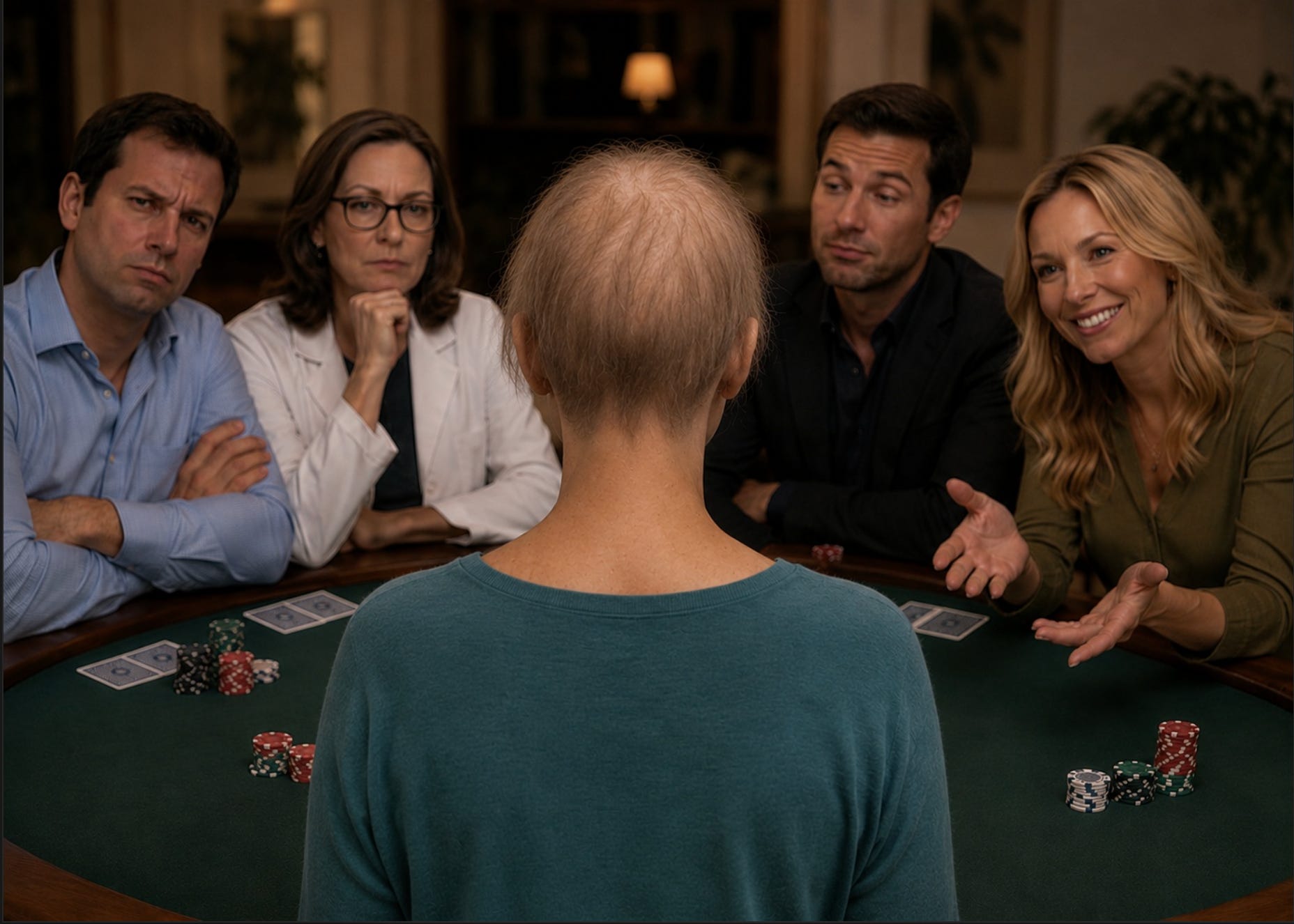
(Notice who’s got cards, who’s engaged… and who’s not…)
Let’s start with the oncologist.
He’s holding the strongest hand at the table. Protocol cards — tested, documented, institutionally backed. He plays them the same way every time because that’s what his game requires. Deviation isn’t just discouraged, it’s professionally dangerous. His job is to beat the tumour. Not to beat the side effects. Not to protect your heart, your kidneys, your liver, your quality of life going forward. The tumor. That’s the whole game for him.
He’s not a villain. He’s just playing the hand he was dealt — inside a system that only rewards one kind of win.
The GP.
Holds the referral cards. Powerful in a specific gatekeeping way — she decides who else gets to sit down at your table. But she only plays when you activate her. And you’re the only one who can do that — bring her the right question at the right moment and she can open a door. Get it right and she calls in a ringer. Someone brought in specifically because they’re exceptional at one part of the game. A specialist who plays at a level nobody else at your table can match.
But she can’t play every hand. And you can’t call in a ringer every time.
So you have to choose. With no rulebook. No map of what’s coming. No idea how many more hands there are to play. You’re rationing calls for help you don’t fully understand, in a game you didn’t choose, at a table you can’t leave.
Nobody told you that part either.
The specialists.
Cardiology. Hepatology. Endocrinology. Each one holds peer-level credibility cards — the kind that enter a room as professional voices, not patient complaints. These are the cards nobody told you existed. Your oncologist has to look at them. He doesn’t have to like them. He doesn’t have to act on them. But he has to receive them. And that’s a different weight entirely than you raising your hand.
The problem: you have to know to ask for them. You have to convince the GP it’s time to bring in a ringer — that this hand is the one that matters, that the pot is worth protecting, that every chip you lose now is one you can’t get back later. She has to understand the stakes well enough to offer them a seat at the table.
And you have to make that case without a rulebook, without knowing how many hands are left, and without any guarantee the ringer who sits down will even understand what game you’re actually playing.
The Naturopath.
This is the one who actually knows you.
Not your file. Not your tumor markers. Not the labs your oncologist orders and reads in isolation. He knows what your body looked like a year ago and what it looks like now. He knows how hard you worked to fix your sleep. What you rebuilt in your nutrition. How your nervous system has been tracking through all of it. He’s watched you do the work — the unglamorous, incremental, deeply intentional work of healing a body that was already under siege before the chemo started.
He’s also the one who got results. His protocol — hyperthermic treatment, high-dose vitamin C, mistletoe therapy alongside conventional treatment — had a tumor you could physically feel nearly disappear in two weeks. His judgment, his knowledge of your body specifically, said it’s time to seriously consider adding chemo. Not because the protocol said so. Because he knew you well enough to read the moment.
He is a Fellow of the American Board of Naturopathic Oncology. Eighteen years of clinical focus specifically on integrative cancer care. The most complete picture of anyone at this table. The most tangible outcomes.
He has a seat at the table. He can see every hand.
And the system won’t let him play.
His cards are treated as foreign currency — real value, wrong denomination. Not because his observations are wrong. Not because his outcomes are in question. But because his evidence wasn’t generated inside the right pipeline. So it doesn’t count. It doesn’t enter the room. It doesn’t move the needle.
The most qualified person at the table.
Forced to watch.
And then there’s you.
No cards. No rulebook. No one at the table expecting you to do anything except sit there and receive.
But here’s the thing nobody says out loud: everyone else at this table is just playing the game. For them it’s a profession, a protocol, a shift that ends at five. They’re good at it. Some of them even care deeply.
But none of them need to win the pot.
You do.
Your life literally depends on it.
The house.
The house isn’t a person. That’s the first thing to understand. There’s no villain in a back room deciding your fate. No single bad actor to confront, expose, or defeat. That would almost be easier.
The house is the structure itself. Protocol. Liability. Funding models. Credentialism. Institutional inertia so old it’s calcified into assumption. It was never built to serve the patient. It was built to sustain itself — and it does that exceptionally well.
It wins when your oncologist stays inside protocol because deviation creates legal exposure. It wins when your specialists don’t talk to each other because the system was never designed for that conversation. It wins when your integrative physician’s clinical observations get dismissed not because they’re wrong but because they weren’t generated inside the right pipeline. It wins when you’re too exhausted, too sick, too overwhelmed to ask the next question.
It wins when you don’t know you’re supposed to be playing.
My hand without cards.
Here’s when everything changed.
Not when I got the diagnosis. Not when I sat down at the table for the first time, stunned and compliant and grateful anyone was dealing me in at all. It changed when I started noticing the gap between what the system said it was doing and what it was actually doing.
My oncologist was winning. The tumor was responding. By his metrics, we were succeeding.
But I knew something he didn’t factor in. My naturopath had been running a parallel protocol the entire time — hyperthermic treatment, high-dose vitamin C, mistletoe therapy, all of it targeted and intentional. He was giving me instructions at every step. He was reading my body in ways the oncologist never looked for. The result we were celebrating at the conventional table? It wasn’t just one player’s hand. It was two.
One of them gets the credit. The other isn’t allowed to claim it.
My heart was taking hits. My liver. My kidneys. My quality of life on the other side of this — the life I’m fighting to get to — was being quietly mortgaged to pay for today’s win.
And nobody at the table was going to flag that. Because nobody at the table was playing for that.
So I started learning the game.
I found out there were cards I didn’t know existed. That specialists could put concerns on record in a language my oncologist couldn’t professionally dismiss. That peer-level clinical documentation carries different weight than a patient raising her hand. That the referral system, for all its gatekeeping dysfunction, could be navigated if you understood whose hand held which card.
I started asking different questions. Not just what are we doing — but why this, why not that, who else needs to be at this table, and what happens to the rest of my body while we’re busy winning the one game everyone agreed to play.
Nobody expected that.
The system is extraordinarily good at what it does. It is not good at patients who do their homework. Who show up with research. Who ask about alternatives that exist outside the protocol. Who understand that “this is standard of care” is the beginning of a conversation, not the end of one.
And here’s what makes it even harder.
In a card game you eventually see who’s holding trump. The hand plays out and the winner becomes clear. But in this game — even after months at the table, even after learning the players and finding cards I wasn’t supposed to have — I still don’t fully know who has the power to change anything.
Can the cardio-oncologist override the oncologist? Not exactly. Can the GP force a protocol change? No. Can the specialist’s documentation move the needle or does it just sit in a file somewhere? I don’t know yet. I’m waiting for the hand to play out. Watching what the GP plays. Watching what the oncologist does when a peer puts something on record. Waiting to see whose card lands as trump.
And that’s the part that’s genuinely scary. Not just that the cards were stacked against me. But that as the patient — the only one at this table who can’t afford to lose — I’m still waiting to find out who actually holds the winning hand.
Nobody told me that part either.
I wasn’t supposed to have cards. I was supposed to watch.
I picked up a hand anyway.
The pot.
You’ve got to know when to walk away. Know when to run.
Except I can’t.
I can’t fire my oncologist mid-chemo and walk out into a better system. I can’t opt out when my life is the pot. I can’t fold this hand and wait for a better deal. Walking away isn’t a move available to me. Running isn’t either.
And that’s the part nobody sings about.
The cards were stacked against me before I sat down. I just didn’t know it yet.
But here’s what I also know: the system counts on your compliance. Not your stupidity. Not your weakness. Your compliance. It was designed for patients who receive. Who trust. Who show up, hold out their arm, go home, and come back when they’re told.
It was not designed for a patient who reads the table.
So you do the only thing left. You learn to play a table that was never set for you. You find the cards nobody offered you and you pick them up anyway. You activate the right players at the right moments even when nobody gave you the timing. You keep asking the question nobody expects you to ask.
And somewhere in the game — with the cards stacked against you, on a table you never asked to sit at — you find an ace you didn’t know you had.
The dealin’s not done yet.
I’m writing this from my chemotherapy chair. I look around the room at the other patients and I wonder — do they know what game they’re playing? Do they know who’s holding the cards? Does their hand feel as empty as mine did when I first sat down?
If any of this resonates — if you’ve sat at this table, if you’ve figured out a move nobody told you existed, if you found an ace you didn’t know you had — I want to hear about it. Share your hand in the comments.
The more we compare notes, the better we all get at playing a game that was never designed for us to win.
"You learn to play a table that was never set for you." I can't help but think that's most systems surrounding us. Schools for special needs kids, for instance. And few ask any questions but quietly receive. Because that's what we taught, especially in Canada/Ontario, healthcare is mostly free, covered by OHIP, which we should be grateful for. Education up to grade 12 is free. Not saying we shouldn't count our blessings, but we shall always reserve our rights to ask questions and trust our intuition (body or mind). And never be afraid to bring your own players to the table, whether the organization/authority that sets the table likes it or not. I know, easier said than done. Thank you for sharing. Your courage and tenacity continue to awe me. Thank you. 💗
Thank you Lisa! And yes, it seems that there are many systems in place today where the status quo is there to serve these systems - not the people the systems were built for. I call on all of us to keep raising these issues to find others who are also realizing this - we need to come together to force change to happen. We need to find our people!